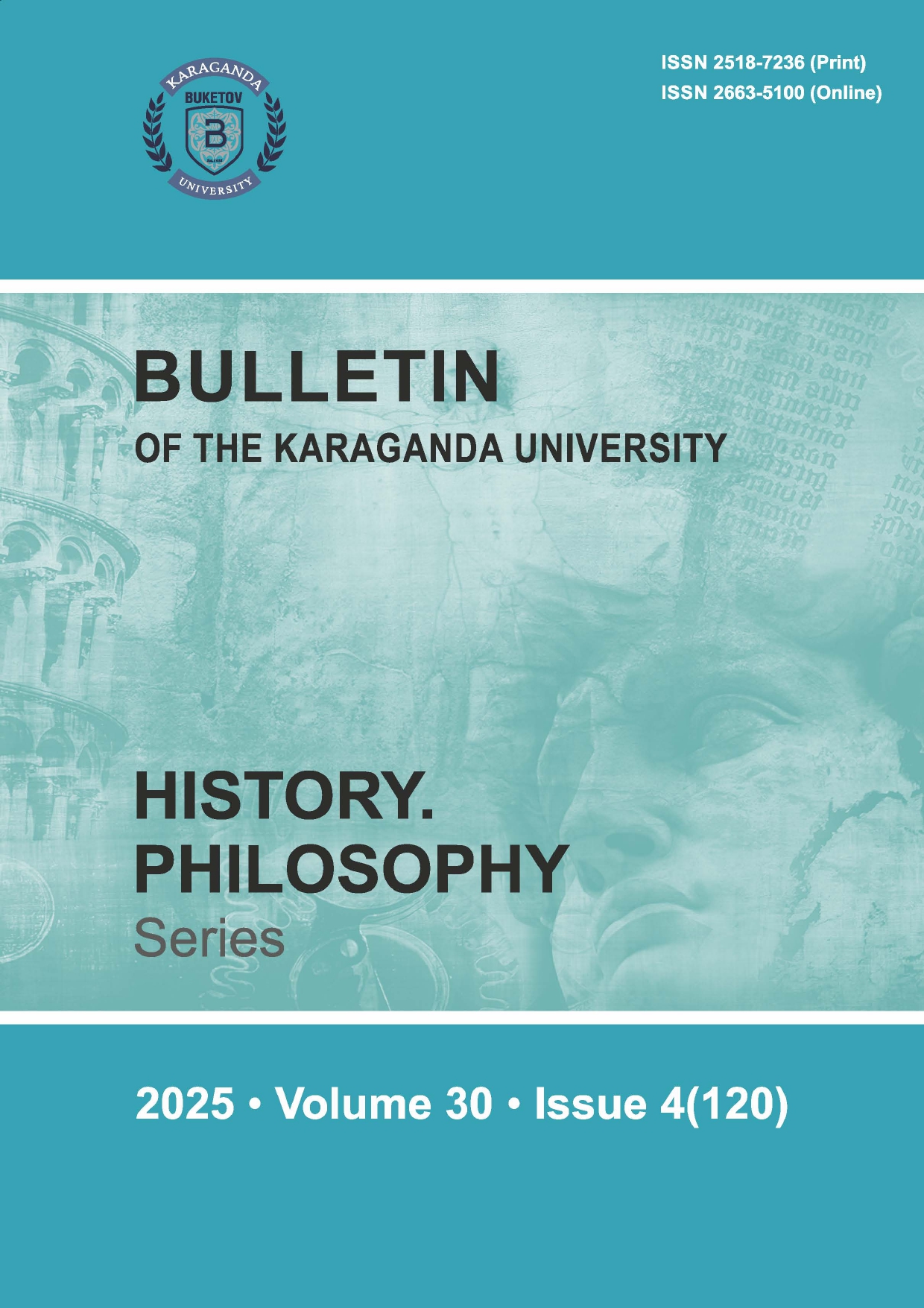
About the Journal

The purpose of the journal is to publish the results of scientific research on topical problems of history and philosophy in the original articles of the authors, to contribute to the development of international scientific cooperation, to strengthen the role and importance of historical knowledge in society, to solve urgent problems of the social sciences and humanities.

The objectives of the journal are to create an open platform for scientific discussions among scientists; expanding the availability of research results of scientists and the exchange of knowledge and professional experience between researchers; the formation of a new view on the history and place of Kazakhstan in it, based on modern scientific approaches and a wide range of historical sources.

The editorial policy of the “History. Philosophy Series” is defined by key trends in the development of philosophical concepts reflecting the diversity of the world and its future. The journal's main research areas are defined by a thematic index, which assumes the publication of scientific articles on the history of philosophy, epistemology, social philosophy, and philosophical anthropology. The processes taking place in the modern world determine the main priorities of scientific publications. Series “History. Philosophy” is focused on the presentation of the main achievements of national and foreign scientists in the socio-humanitarian sphere.The relevance of published articles is confirmed by the fact that the series “History. Philosophy ”is also a dialogue platform on the main problems of modern society regarding the development of spiritual, historical, philosophical scientific trajectories. Series “History. Philosophy” provides an opportunity to publish not only venerable, well-known scientists, but also young researchers who continue the traditions of academic science or create original ideas about the ways and forms of cognitive heuristics. The publication is aimed at a professional audience, as well as a wide range of readers interested in worldview problems and the current socio-humanitarian situation.

Editorial policy of “Series History. Philosophy ” was updated and approved at a meeting of the editorial board from 06.04.2020. Minutes No. 2.

Thematic focus
 is associated with the main research priorities in the socio-humanitarian scientific space. As the main areas of the “Series History. Philosophy” states the following: actual problems of world history; the history of Turkic peoples, National history, anthropology, ethnology, source studies, historiography, archival studies, museology, philosophy.
 

Periodicity: «Bulletin of the Karaganda university. History. Philosophy series» is published four times a year (once a quarter).

Terms of publication: for publication in the journal “Bulletin of Karaganda University. History. Philosophy series” are accepted articles containing the results of fundamental and applied research in the field of social sciences and humanities.

Only materials corresponding to the profile of a scientific periodical are accepted for publication. They should be relevant, new, have scientific and practical significance.

Presenting the text of the work for publication in the journal, the author guarantees the correctness of all information about himself, the absence of plagiarism and other forms of unlawful borrowing in the manuscript of the work, the proper design of all borrowings of text, tables, diagrams, illustrations.

Reviewing process: Manuscripts of scientific articles in the journal are peer reviewed in order to ensure academic quality, as well as the correctness and reliability of the presentation of the results. Peer review maintains a high scientific and theoretical level for publications, and confirms the selection of the most relevant and significant scientific works.

All articles should be submitted to the editorial office of the journal “Bulletin of Karaganda University. History. Philosophy series” so that they may undergo an primary expertise and peer review.

The editorial board of the journal has adopted international standards for double-blind peer review: To ensure the objectivity of the recommendations received, the identity of reviewers is not disclosed to authors or other reviewers (unless reviewers themselves request that their names be disclosed). Reviewers, who are specialists in the relevant field of research, are appointed by the chief editor, from among the leading specialists in the profile of the article. All reviewers must adhere to the ethical requirements of scientific publications, requiring them to be objective and impartial.

Peer reviewing is carried out confidentially. If the article is rejected by reviewers, a refusal notice will be sent to the authors indicating reasons for rejection. The period for peer reviewing articles will be no longer than three weeks.

Peer review indicates the relevance of the article, the reliability of the research results, the degree of their novelty, scientific and practical significance. The main disadvantages, defects of the material (if any) are also indicated.

The peer reviewer makes a conclusion about the possibility of publishing the article: accept (including with minor corrections); conditionally accept (with revision and re-review); or reject.If given a positive review, the article will be submitted to a meeting of the editorial board. In the presence of any objections by a peer reviewer, which require revisions to the article, it will be sent to the author for revisions. After receiving the opinion of the peer reviewer, the issue of when to insert the said article for publication will be considered at an editorial board meeting.

In the case of a negative review, the work will be sent for subsequent examination.

With two negative reviews, the author is given a reasoned refusal, certified by the Editor-in-Chief. If the second review is positive, the issue of publication after requisite revisions will be discussed at an editorial board meeting.

The reviewing process was updated and approved at a meeting of the editorial board from 06.04.2020. Minutes No. 2.

Archive and availability of scientific articles: published articles are posted on the journal's website - the "Archive" section. Contents of the journal “Bulletin of Karaganda University. Series History. Philosophy ”is in the public domain and provided free of charge to users and their organizations. Users are allowed to read, download, distribute, copy, print, search, or link to the full text of documents without prior permission from the publisher or author.

Validation for articles: A scientific article must contain the results of original scientific research that has not been previously published and is not intended for publication in other publications. Checking of scientific articles for plagiarism is carried out by the executive secretary.

Verification of scientific articles for the presence of borrowings is carried out using the "Antiplagiat" system» (Strikeplagiarism.com or antiplagiat.ru).

A scientific article should contain the results of original scientific research previously unpublished and not intended for publication in other publications. Scientific articles submitted for publication in scientific journals should comprise at least 70% of the original text. If the article does not comply with the originality standard, the article is sent for revision with a printout of the audit report. If the article is not corrected or, after refinement, it does not meet the standards of originality, the editorial board decides on the inadmissibility of its publication.

General information:

1. The scientific journal of the «Bulletin of the Karaganda university. History. Philosophy series» registered by the International Center for Registration of Serials ISSN (UNESCO, Paris, France) ISSN 2518-7236 (Print), ISSN 2663-5100 (Online).

2. The scientific journal of the «Bulletin of the Karaganda university. History. Philosophy series» registered by the Ministry of Culture and Information of the Republic of Kazakhstan. Registration certificate No. 13108-Zh. 23.10.2012

3. Bulletin of the Karaganda university. History. Philosophy series» is included in the list of publications recommended by the Committee for Control in the Sphere of Education and Science.  December 27, 2012, No.1735; Much 18, 2021, No.256

4. The journal “Bulletin of Karaganda University. Series History. Philosophy ”and published articles are assigned a digital object identifier - DOI.

5. The journal “Bulletin of Karaganda University. Series History. Philosophy ”is registered in the RSCI. All articles are indexed in the RSCI and placed in the public domain in the Scientific Electronic Library of the RSCI on the website elibrary.ru in PDF format.

Languages of publications: Kazakh, Russian, English.

Current Issue

Vol. 30 No. 4 (120), 2025
					View Vol. 30 No. 4 (120), 2025
Published: 2025-12-30

HISTORY

  • The History of the ‘New Economic Policy’ in the Soviet State in the 1920s of XXth century

    Bitimbek Adambek
    7-15
    DOI: https://doi.org/10.31489/2025hph4/7-15
  • Preservation of the National Identity of Kazakhs in Turkey: The Role and Legacy of Khalifa Altai

    Ainur Aliakbarova, Ақмарал Оспанова, Zhanar Smakhanova
    16-26
    DOI: https://doi.org/10.31489/2025hph4/16-26
  • Gender as a Category of Historical Analysis: the Methodology of Gender History

    Assem Aubakirova
    27-35
    DOI: https://doi.org/10.31489/2025hph4/27-35
  • The Campaign of Confiscation and Forced Collectivization in Southern Kazakhstan in the late 1920s–early 1930s of the 20th Century

    Elmira Baidalieva, Moldir Aldabergenova, Gulzhan Orynbasarova
    36-44
    DOI: https://doi.org/10.31489/2025hph4/36-44
  • Historiography of the Problem of Kazakh Diaspora in Mongolia

    Gulnara Bayzhuma, Орынгул Табылдиева, Arailym Sadykova
    45-55
    DOI: https://doi.org/10.31489/2025hph4/45-55
  • Children in Conditions of “Peasant Exile” in Kazakhstan in the First Half of the 1930s

    Svetlana Yeleukhanova, Aigerim Utebayeva
    56-64
    DOI: https://doi.org/10.31489/2025hph4/56-64
  • History and Activities of the First Kazakh Institute of Education in Tashkent

    Asylkhan Zholdas , Gaukhar Batyrbekkyzy, Gulden Akhmetshina, Madiyar Zhumabekov
    65-72
    DOI: https://doi.org/10.31489/2025hph4/65-72
  • On the Study of the History of the 1916 Turkestan Uprising through the Lens of School Textbook Analysis

    Mukhayo Iskokova
    73-81
    DOI: https://doi.org/10.31489/2025hph4/73-81
  • The history of the Suzak uprising: what do archival documents reveal?

    Gulbanu Kapbarova, Assel Jumadullaeva, Khazretali Tursun
    82-90
    DOI: https://doi.org/10.31489/2025hph4/82-90
  • The Adaptation Issues of Special Settlers from the North Caucasus in Kazakhstan: Medical Care and Education

    Talgat Makalakov
    91-100
    DOI: https://doi.org/10.31489/2025hph4/91-100
  • Poles in the Development of Virgin and Fallow Lands in Northern Kazakhstan

    Arailym Mussagaliyeva, Roza Mussabekova
    101-112
    DOI: https://doi.org/10.31489/2025hph4/101-112
  • Methods and Language of Official Business Communication in the Ulus of Jochi

    Gulnur Narymbet, Zhanar Muldakhmetova, Nurbek Baimakhanov, Aidarbek Amirbek
    113-121
    DOI: https://doi.org/10.31489/2025hph4/113-121
  • The Religious Situation during the Great Patriotic War and the Early Postwar Years: A Case Study of the History of the Russian Orthodox Church in Kazakhstan

    Aigerim Orazbaikyzy, Talgat Zholdassuly
    122-132
    DOI: https://doi.org/10.31489/2025hph4/122-132
  • History and Main Directions of Turkish Foreign Policy in the Interwar Period (1918–1939)

    Gulzhan Otarbayeva, Akzharkyn Otarbayeva
    133-140
    DOI: https://doi.org/10.31489/2025hph4/133-140
  • The Problem of Sedentarization of the Kazakhs of Central Kazakhstan in the 1930s

    Zauresh Saktaganova, Tolkynay Sakabay
    141-149
    DOI: https://doi.org/10.31489/2025hph4/141-149
  • Kazakh Bais and Their Role in the Development of Society in the Late 19th and Early 20th centuries

    Nurzhan Salauat
    150-158
    DOI: https://doi.org/10.31489/2025hph4/150-158
  • Accounts of the Capture of Baghdad and the Political Role of Hulagu Ilkhan in “Zubdat al-Fikra”

    Samal Tuleubayeva, Zhaksylyk Sabitov, Assel Tashkaraуeva
    159-172
    DOI: https://doi.org/10.31489/2025hph4/159-172
  • Intellectual History: Formation and Methodological Features of a Scientific Field

    Zhanibek Tuleubayev, Makhabbat Kozybayeva, Khalil Maslov, Yerden Kaldybekov
    173-183
    DOI: https://doi.org/10.31489/2025hph4/173-183
  • The Implementation of the Imperial System of Governance in Semirechye in the second half of the 19th and the beginning of the 20th centuries

    Akmaral Yskak, Gabit Zhumatay
    184-197
    DOI: https://doi.org/10.31489/2025hph4/184-197

PHILOSOPHY

  • New perspectives on the application of Jacques Derrida’s deconstruction

    Ye.K. Chongarov, K.S. Bagasharov, N.E. Tutinova
    198-205
    DOI: https://doi.org/10.31489/2025hph4/198-205
  • The Philosophy of the Rider and Artificial Intelligence: Movement, Freedom, Power

    B.M. Amantay
    206-215
    DOI: https://doi.org/10.31489/2025hph4/206-215
  • Visual anthropology and the phenomenology of the gaze in cinema

    E.Yu. Aleinikova, T.Yu. Lifanova, S.A. Lifanov
    216-228
    DOI: https://doi.org/10.31489/2025hph4/216-228
  • Collective Errors and Mechanisms of Deception: From John Locke’s Typology of Mistakes to Contemporary Epistemology

    Shams A. Bunyatova
    229-240
    DOI: https://doi.org/10.31489/2025hph4/229-240
  • Strategic hybridity: National modernization and cultural security in Kazakhstan and Kyrgyzstan

    A.G. Gappassova, Y.Zh. Anlamassova, A.I. Mambetova, Kh.S. Abdildina
    241-250
    DOI: https://doi.org/10.31489/2025hph4/241-250
  • Modern markers of myth definition

    B.Zh. Zhussupova
    251-259
    DOI: https://doi.org/10.31489/2025hph4/251-259
  • Continuity of health of soul and body: in the context of philosophical views and medical paradigms

    N.A. Meiramova, A.O. Tursynbaeva
    260-266
    DOI: https://doi.org/10.31489/2025hph4/260-266
  • Reconfiguration of Kazakh Ethnoaesthetics: Searching for New Artistic Paradigms in the Context of Cultural Globalization

    G.A. Naizabayeva, K.S. Yermagambetova, T.Kh. Gabitov, Z.A. Abduazimova
    267-276
    DOI: https://doi.org/10.31489/2025hph4/267-276
  • Philosophy of life in the context of neonomadism: traditions and modernity

    A.T. Omarova, B.O. Mukanov, L.M. Dauletbayeva
    277-286
    DOI: https://doi.org/10.31489/2025hph4/277-286
  • Formation of personality in the context of the mythological form of spiritual communication from the archetype to mass culture

    G.R. Seifullina, A.E. Kabduyev, E.А. Mussayeva
    287-293
    DOI: https://doi.org/10.31489/2025hph4/287-293
  • Transformation of youth national identity in the context of globalization

    B.B. Shikirtayev, V.A. Yessengaliyeva
    294-301
    DOI: https://doi.org/10.31489/2025hph4/294-301
  • Artificial Intelligence and the Philosophy of Labour: Challenges and Prospects

    H.A. Shimshek, G.B. Kolegen
    302-308
    DOI: https://doi.org/10.31489/2025hph4/302-308
  • Scholar Amangeldy Aitaly and the phenomenon of national identity: interrelation of culture, language, and national consciousness

    A.Ch. Yeshniyazova, T.Kh. Ryskaliev
    309-318
    DOI: https://doi.org/10.31489/2025hph4/309-318
  • Morality and religion in the context of Kazakh philosophy

    N.Sh. Ybyray
    319-330
    DOI: https://doi.org/10.31489/2025hph4/319-330
View All Issues